Here’s a number that for sure makes every business owner pause for a moment. Over 50% of customers will switch brands after just one bad experience (one, and that’s it!). No second chances, no benefit of the doubt; just gone.
So how do you actually know if your customers are happy before they walk out the door?
That’s exactly where CSAT comes in. If you’ve been googling “CSAT meaning” and getting buried under jargon-heavy explanations, you’re in the right place.
We’re breaking down what this metric really is, why it matters more than ever in 2026, and how you can start measuring it the smart way, without drowning in spreadsheets.
Ready to figure out what your customers truly think?
Let’s start with the basics: what exactly is a (CSAT) customer satisfaction score?
What is CSAT score?
A CSAT score (customer satisfaction score) is basically a quick pulse check on how happy your customers are with a specific interaction, product, or service.
Think of it like that “How did we do?” survey you get after a support chat or a delivery. Customers rate their experience, usually on a scale of 1 to 5, and the responses get crunched into one simple percentage.
The primary goal here isn’t to flatter your team’s ego with a high number. It’s to spot patterns: where you’re winning customers over and where you might be quietly losing them. It’s one of the easiest ways to put a real number on something that feels abstract (happiness).
Significance of customer satisfaction score
Now, since you have already learned the CSAT score meaning, let’s have a look at why it is so important:
- Reduces churn: Happy customers don’t go shopping for alternatives. CSAT actually works as an early warning system. It helps you catch churn risk before customers actually cancel, instead of finding out the hard way after they’ve already left.
- Boosts revenue & loyalty: This one’s straightforward: a small bump in CSAT can translate into a noticeably bigger lift in customer retention, and retained customers are far cheaper to keep happy than new ones are to acquire.
- Measures service quality: CSAT puts a number on something that used to be a gut feeling. Instead of guessing whether your support team is doing a good job, you get real, comparable data straight from the people who experienced it.
- Provides actionable insights: Every low score comes with a “why” attached if you ask the right follow-up question. That feedback loop tells you exactly what to fix (slow replies, confusing processes, unhelpful answers), instead of leaving you to guess.
- Drives word-of-mouth referrals: People love talking about good experiences just as much as bad ones. Customers who walk away happy tend to tell several other people about it, which means a solid CSAT score quietly fuels your marketing without spending a single rupee on ads.
What is a good CSAT score
There’s no single magic number here!
What counts as a “good customer satisfaction score” really depends on your industry, your customers’ expectations, and what you’re benchmarking against.
That said, here’s a general scale most businesses can use as a quick gut check.
- 90%+ (exceptional)
You’re not just meeting expectations; you’re blowing past them. Scores this high usually mean your product, support, and overall experience are firing on all cylinders.
- 80%–89% (excellent)
This is the sweet spot most brands strive for. You’re clearly doing a lot right, even if there’s still a little room to polish things further.
- 75%–79% (good)
A solid, healthy score. Customers are walking away satisfied more often than not, though there’s likely still some friction worth smoothing out.
- 70%–74% (average/acceptable)
Not bad, but not something to celebrate either. You’re keeping customers reasonably happy, but competitors with stronger CX could start pulling ahead.
- Below 70% (needs improvement)
This is your wake-up call. Something in the experience, whether it’s support, product quality, or response times, needs immediate attention before it starts costing you customers.
Industry benchmarks for CSAT scores
Comparing your score to a generic global average doesn’t tell you much. What actually matters is how you stack up against others in your specific industry, since expectations and norms shift a lot from sector to sector.
- Financial services & banking: 80%–83%
Trust is everything in banking, so customers expect accuracy, security, and zero room for error, which keeps the bar high.
Target: ≥ 88%
- Software / SaaS: 79%–80%
With endless alternatives just a click away, SaaS users expect smooth onboarding and fast support, making this one of the most competitive spaces for CSAT.
Target: ≥ 88%
- E-commerce & retail: 78%–80%
Shoppers judge you on the entire customer journey (browsing, checkout, delivery, and returns), so even one weak link can drag your score down.
Target: ≥ 87%
- Full-service restaurants: 81%–84%
Food, service, and atmosphere all factor in here, and the personal nature of dining out tends to push satisfaction scores a bit higher across the board.
Target: ≥ 89%
- Healthcare: 74%–78%
Between long wait times, paperwork, and the emotional weight of care, healthcare naturally faces a tougher road to high satisfaction.
Target: ≥ 86%
- Telecommunications & internet providers: 65%–74%
Frequent outages, billing confusion, and long hold times have made this one of the hardest industries to score well in.
Target: ≥ 80%
How to calculate CSAT score
Good news: The math behind this metric is refreshingly simple; no advanced degree in statistics required.
Here’s how the whole process works, step-by-step:
Step #01: Data collection
Everything starts with sending out a quick satisfaction survey right after a customer interacts with your product, support team, or service.
Keep it short; usually just one quick question like “How satisfied were you with your experience?” on a 1-to-5 Likert scale, since long customer surveys tend to get ignored or abandoned halfway through.
- Very Unsatisfied
- Unsatisfied
- Neutral
- Satisfied
- Very Satisfied
Step #02: Spot positive responses
Once the responses start rolling in, you’ll need to separate the happy customers from the rest.
Anyone who rated their experience a “4” or “5” counts as satisfied. Ratings of “1”, “2”, or “3” don’t make the cut, even if a 3 feels like a neutral score on paper.
This is the foundation of the entire customer satisfaction score calculation, so getting this sorting step right really matters.
Step #03: CSAT example calculation
Now for the easy part. The customer satisfaction score formula is just: divide the number of satisfied customers (those 4s and 5s) by the total number of responses, then multiply by 100 to get a percentage.
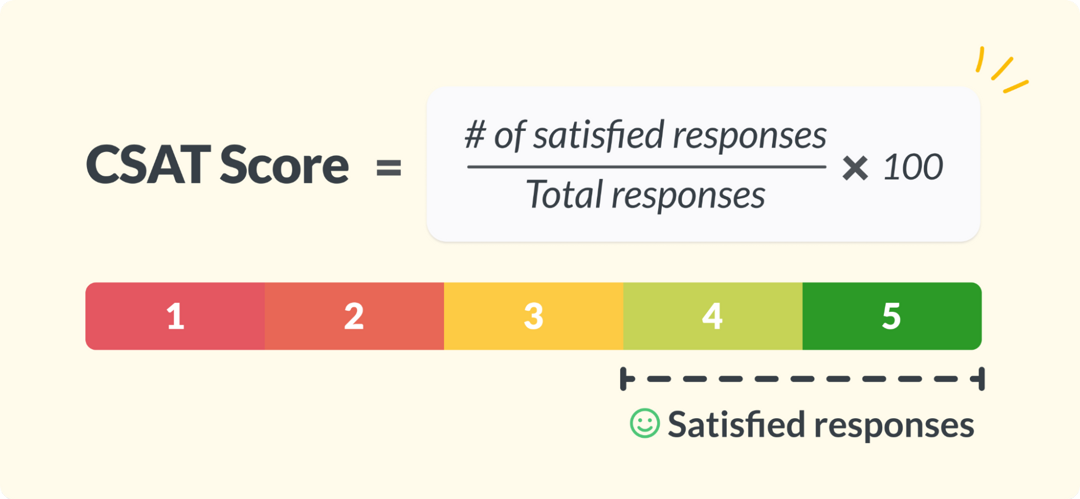
Let’s say 200 people responded to your survey, and 150 of them rated you a 4 or 5. That’s 150 divided by 200, which gives you 0.75. Multiply that by 100, and you land on a CSAT score of 75%.
Simple, clean, and something you can track over time to see if you’re actually moving in the right direction.
How do you measure customer satisfaction score?
Measuring CSAT isn’t really about complicated tools or fancy dashboards. It’s about asking the right question at the right time.
Most businesses rely on something called the “Likert scale”, which is just a fancy term for those simple rating options you’ve probably answered a hundred times yourself:
- Very Dissatisfied,
- Dissatisfied,
- Neutral,
- Satisfied,
- Very Satisfied
Often paired with numbers 1 through 5.
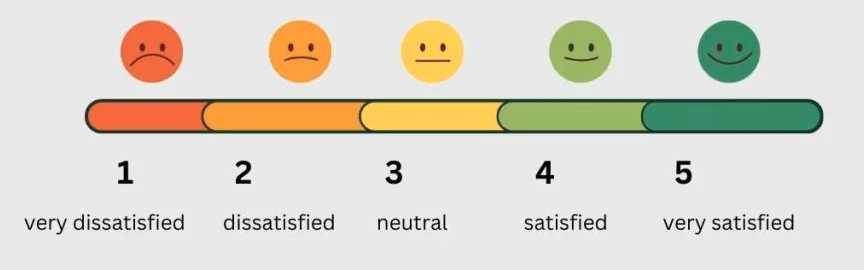
You’ll usually see this pop up right after a support call ends, a purchase goes through, or a feature gets used for the first time.
The trick is timing it well. Ask too early, and customers haven’t formed an opinion yet. Ask too late, and they’ve probably forgotten the details. Catch them right after the experience, and you’ll get honest, accurate feedback that actually reflects how they feel in that moment.
Pros & cons of CSAT
Like any metric, CSAT has its strengths and its blind spots, and knowing both helps you use it the smart way instead of relying on it for everything.
| Pros | Explanation |
| ✅ Simple & intuitive | One question, one scale! Customers and your team get it instantly without any confusion. |
| ✅ High response rates | Short surveys mean people actually finish them instead of abandoning halfway through. |
| ✅ Pinpoints specific touchpoints | You can tie feedback to one exact moment, like a support call or checkout step, instead of guessing where things went wrong. |
| ✅ Actionable | Low scores come with clear, fixable problems attached, so your team knows exactly where to focus. |
| Cons | Explanation |
| ⛔ Lacks context | A rating alone doesn’t tell you why someone felt that way unless you add a follow-up question. |
| ⛔ Subjective & transient | Mood, timing, and personal bias can influence a score that has nothing to do with your actual service. |
| ⛔ Does not measure loyalty | A satisfied customer today isn’t necessarily a loyal one tomorrow. That’s a different metric entirely. |
| ⛔ Survey fatigue | Ask too often, and customers start ignoring or rushing through your surveys altogether. |
How to improve CSAT score: Useful tips to follow
Once you know where you stand, the real work begins, i.e., actually moving that number up. Here are some practical, no-nonsense ways to improve customer satisfaction scores over time.
- Speed up your response times. Customers value fast replies more than almost anything else, so cutting down wait times on support and queries can instantly lift satisfaction.
- Train your support team properly. A knowledgeable, friendly agent can turn a frustrated customer into a happy one within minutes.
- Act on the feedback you collect. Don’t just gather CSAT scores and file them away. Actually fix the recurring issues customers point out.
- Personalize the experience. Use customer history and preferences so people feel like a name, not a ticket number.
- Offer support across multiple channels. Let customers reach you through chat, email, or phone, whichever feels easiest for them.
- Close the feedback loop. If someone leaves a low score, follow up and show them you actually listened.
- Keep surveys short and well-timed. Send them right after the interaction, not days later when the details have faded.
CSAT vs. NPS vs. CES
These three metrics often get grouped, but each one answers a different question about your customer experience.
Here’s how they stack up side by side:
| CSAT | NPS | CES | |
| Full form | Customer Satisfaction Score | Net Promoter Score | Customer Effort Score |
| Primary question | “How satisfied were you with this experience?” | “How likely are you to recommend us to a friend or colleague?” | “How easy was it to get your issue resolved?” |
| What it measures | Satisfaction with a specific interaction or touchpoint | Overall loyalty and likelihood to advocate for your brand | The amount of effort a customer had to put in to get help |
| Best use case | Support tickets, purchases, onboarding steps | Quarterly or yearly relationship health checks | Support interactions, returns, troubleshooting steps |
| When to use | Right after a specific moment in the customer journey | Periodically, to track long-term brand perception | Immediately after a customer resolves an issue or completes a task |
Why measure CSAT at present in 2026?
Customer expectations have shifted hard in the last couple of years, and honestly, patience is running thin than ever.
People compare every brand interaction to the smoothest one they’ve had recently, no matter if that’s a banking app or a food delivery service, and they expect you to keep up.
On top of that, the rise of AI-powered support, instant chat, and same-day everything means slow or clunky experiences stand out a lot more than they used to.
CSAT gives you a real-time pulse on whether you’re actually meeting these rising expectations or quietly falling behind. It’s not just a vanity metric anymore; it’s tied directly to retention, referrals, and revenue.
In a year where customers have endless alternatives just a scroll away, knowing exactly where you stand isn’t optional anymore; it’s the difference between growing and slowly losing ground.
How Replug assists in increasing CSAT score
Now that you know what drives a strong CSAT score, let’s talk about a tool that quietly helps you get there.
Replug.io is an all-in-one solution for managing custom shortened links with CTAs, retargeting pixels, and detailed analytics. Among its many features, the custom URL shortener deserves special mention.
Instead of sending customers clunky, generic links, you can create short link options that carry your brand name, look polished, and instantly feel more trustworthy.
Why does this matter for CSAT?
Because trust and ease shape every customer interaction, even something as small as clicking a link. You can create branded or customized links to reinforce your brand identity, making every link memorable and trustworthy. And the best part is, personalized branded short URLs are generated within seconds, with no technical hassle involved.
When every touchpoint feels professional and frictionless, it naturally reflects in your customer satisfaction metrics. So if you’re serious about improving CSAT, start with the small details. Replug helps you nail them effortlessly.
You may also like: 6 ways brands can use Replug to strengthen the customer’s journey
Frequently asked questions

Muhammad Ahsan Jamal