 13 minutes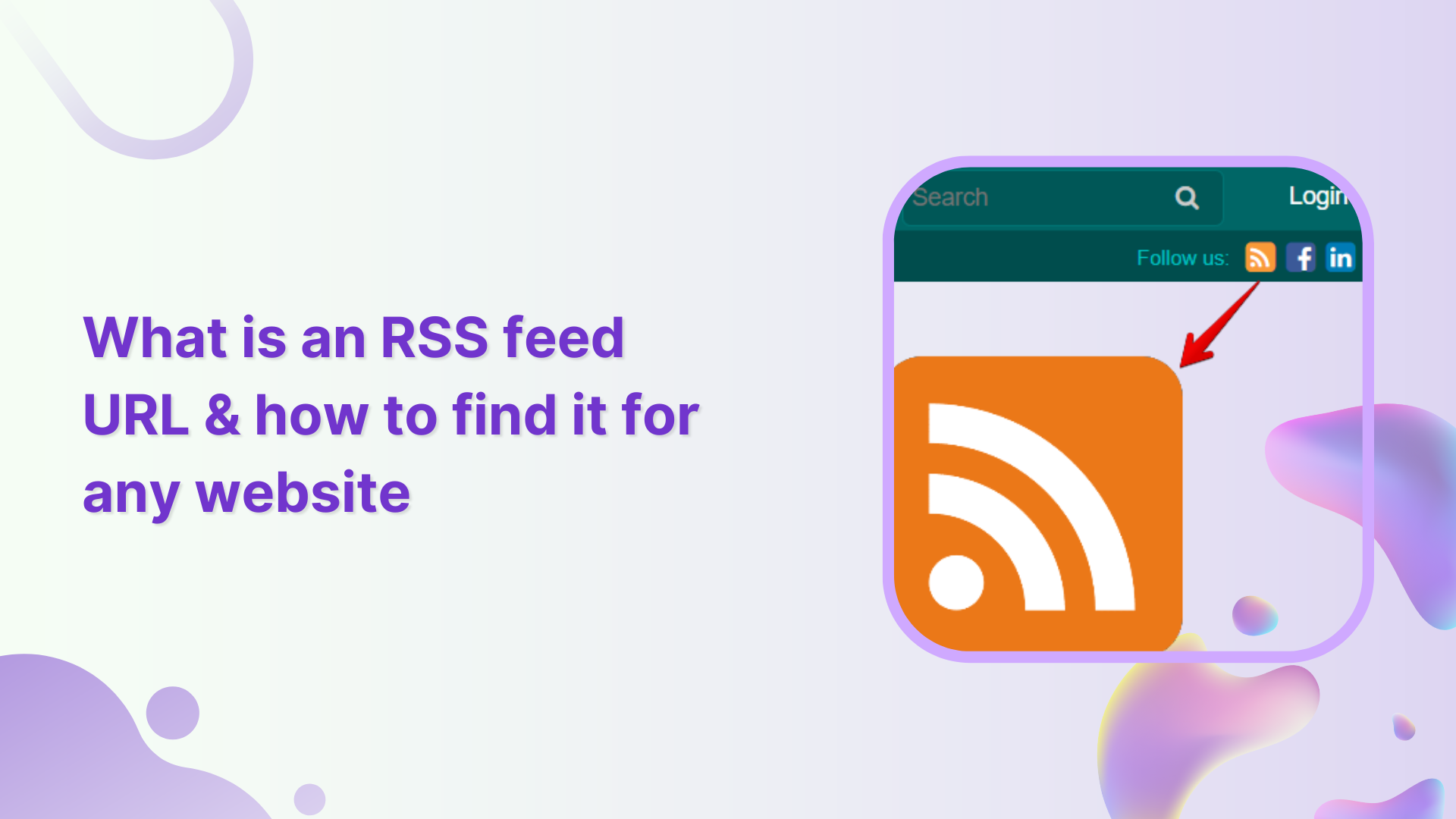
Are you tired of managing bookmarks, refreshing dozens of websites, or missing out on updates because you simply forgot to check? That’s the core problem!
It’s really frustrating, especially when you know the content you care about could land in your inbox the moment it’s published.
But, here’s the good news, guys…
A vast number of sites still publish through RSS, and over 100 million websites are identified as using this technology in the tail-end of 2025.
By learning the right “RSS feed URL”, you can get those updates delivered automatically, without doing the hard work yourself; no more manual checking or refreshing.
Ready to step in? Let’s start with a quick overview: what exactly is an RSS feed URL, and why it matters.
RSS feed URL meaning
An “RSS feed URL” is simply the web address (URL) that points to a site’s feed, a kind of machine-readable summary of everything new on that website.
The feed (often in XML format) lists the latest posts, news, articles, or media, letting you know when new content is published.
The primary objective of that URL is to give you a single, reliable link that any “RSS reader” (also called a feed reader or aggregator) can visit regularly to check for new content.
Instead of you opening dozens of websites manually, the reader fetches updates automatically and compiles them into one stream, easy to browse and always up to date.
Why does this matter?
Because with an RSS feed URL, you can:
- Save time, no need to manually revisit each site.
- Get content delivered as soon as it’s published. Nothing gets missed!
- Avoid algorithmic filters or noise that you usually get on social media. You only see what you subscribe to.
In short, grabbing a site’s RSS feed URL gives you a direct, streamlined line to all its latest content; neat, efficient, and under your control.
RSS feed URL structure
When you get hold of an RSS feed URL, it helps to know that there are some common patterns or “formats” that many websites follow. This makes it pretty easy to guess or locate the feed if it’s not obvious.
Common RSS feed URL formats
Many sites use simple, predictable URL patterns for their feeds. Some of the most common are:
- https://example.com/feed/ (a generic feed link).
- https://example.com/rss/ (another frequent pattern).
- https://example.com/rss.xml or https://example.com/feed.xml (especially when the feed is provided as an XML file).
- For some websites structured with subfolders or sections, you might see variants like https://example.com/blog/feed/ or https://example.com/blog/rss/.
Note: These patterns aren’t universal. Some sites hide their RSS feeds, give them custom URLs, or even omit them altogether. But starting with these standard formats is often the quickest way to find a feed, especially if the site is built on a common platform (like those that auto-generate feeds).
RSS feed URL examples
Here are a few concrete examples to give you a clearer idea:
- If a blog lives at https://myblog.com, its feed might be https://myblog.com/feed/
- Another site might offer its feed at https://news.example.com/rss.xml
- A blog’s older implementation could use https://example.com/blog/rss/ or https://example.com/blog/feed.xml
When you paste one of these into an RSS reader (or simply your browser), you’ll often see a basic XML file: with <rss> at the top, a <channel> describing the feed, and multiple <item> entries, each representing a post or article.
How to find an RSS feed URL
When you want to subscribe to a website via RSS, the tricky part is often just finding the correct link, i.e., the actual RSS feed URL. Below are four friendly, reliable ways to track it down hassle-free!
Method #01: Look for the RSS logo
Many websites still show the classic orange RSS icon (or a similar feed icon) somewhere on their pages, often in the header, footer, or sidebar. If you spot it, click on it. That almost always leads you directly to the RSS feed URL.
Method #02: Check the page source
If there’s no visible icon, you can look under the hood. Right-click on the page, choose “View page source” or “Inspect”. Then search with “Ctrl + F” or “Cmd + F” for keywords like “RSS” or “feed”. If a feed exists, you’ll likely find a <link rel=”alternate” type=”application/rss+xml” tag; the “href=” value is the feed’s URL.
Method #03: Guess common suffixes
A lot of sites, especially blogs and those built on popular platforms, use simple, predictable endings for their feed URLs. Common guesses: adding /feed, /rss, /feed.xml, or /rss.xml to the site’s base address (e.g., https://example.com/feed/).
Note: You can also try /blog/feed/ or /blog/rss/ if there’s a blog section. It doesn’t always work, but when the site follows conventions, this method often hits the mark.
Method #04: Use platform-specific methods
Depending on the platform the website runs on (e.g., WordPress, Blogger, or others), shortcuts are available.
For instance, many WordPress-powered sites make their feed available at /feed/. However, if the site is newer or uses a custom CMS, you may need a browser extension (or an RSS feed URL finder) that scans page metadata or the site’s structure to detect a feed automatically.
Using these methods, from obvious to more technical, you can usually uncover a website’s RSS feed URL within a minute or two.
How to find the RSS feed URL for the most popular websites
Now, if you are someone who wants to follow big sites, blogs, or social platforms via RSS feed URLs, it helps to know their typical feed-URL formats.

Mentioned next are many of the most popular websites, along with how you can find or build their RSS feed URL so you can subscribe easily.
YouTube RSS feed URL
For YouTube channels or users, the feed URL often uses this format:
https://www.youtube.com/feeds/videos.xml?channel_id={CHANNEL_ID}
You just need the channel’s unique ID (or username in some cases) and place it in the URL. A similar feed URL format also works for playlists.
Reddit RSS feed URL
On Reddit, you can get feeds for the whole site or specific sub-sections. For example:
- Front page: https://www.reddit.com/.rss
- Subreddit: https://www.reddit.com/r/{subreddit-name}/.rss
- User feed: https://www.reddit.com/user/{user-name}/.rss
These links will deliver the latest posts (or comments, depending on the URL) for the chosen Subreddit or user.
Medium RSS feed URL
For Medium content (either for a user, a publication, or a custom domain), the feed URL usually goes like:
https://medium.com/feed/{username-or-publication-name}
If it’s a custom domain, it might simply be /feed appended to the base URL.
Tumblr RSS feed URL
For a blog on Tumblr, just add /rss to the blog’s URL. For example:
https://yourblog.tumblr.com/rss
That’ll work for default blogs. If it’s on a custom domain, the same rule often applies.
Blogger RSS feed URL
For blogs on Blogger (also known as Blogspot), the feed URL often uses this pattern:
https://{blogname}.blogspot.com/feeds/posts/default
This gives you a feed of all blog posts published on that Blogger site.
Wix RSS feed URL
If a site is built with Wix, some of them expose feeds via a “blog-feed.xml” file. So you might try a URL like:
https://www.example-wix-site.com/blog/blog-feed.xml
Note: It’s not guaranteed, because Wix sites vary, but this is a typical pattern.
CNN RSS feed URL
CNN offers RSS feeds for different news categories. One common feed URL is:
http://rss.cnn.com/rss/cnn_topstories.rss
You can subscribe to this (or other category-specific feeds) to get the latest headlines directly via RSS.
RSS feed URL Spotify
For platforms like Spotify, especially if you follow artists/playlists/podcasts, there are services/tools (e.g., online RSS feed URL generators) that can convert your Spotify content into an RSS feed URL in no time at all.
RSS feed URL ESPNcricinfo
If you want updates from ESPNcricinfo, i.e., one of the top cricket news websites, there are official RSS feeds for news, live match updates, player news, series, teams, etc. Their “Cricket RSS feed URL” collection includes global news, live matches, and more.
- Global news feed: https://www.espncricinfo.com/ci/content/rss/news_1.xml, this is their main “all-news” feed.
- Live scores feed: https://www.espncricinfo.com/ci/engine/match/scores/rss.xml (or similar, check their RSS feed index page)
By knowing these standard feed-URL patterns, you can quickly subscribe to many big websites and stay updated without manually checking them.
How to get RSS feed URL for news
Suppose you want to stay updated with the latest news, whether world headlines, tech articles, or niche updates like sports, having the right RSS feed URL makes all the difference.

Here’s how you can easily grab feed URLs for different kinds of news.
General news RSS feed URL
Many major news sites openly provide an RSS feed for their general or “top stories”.
For example, CNN makes its feed available at: http://rss.cnn.com/rss/cnn_topstories.rss.
Similarly, BBC News offers a world news feed at: https://feeds.bbci.co.uk/news/world/rss.xml.
By subscribing to such general news RSS feed URLs, you can get updates covering all major topics (headlines, international affairs, breaking stories, etc.) in one go.
Cricket news RSS feed URL
If you follow sports, say cricket, you can look for news sites or sections that support RSS and target cricket or sports in general.
For example, if a major news publisher has a “sports” or “cricket” section, check if they publish an RSS feed for that section.
Using the term “RSS feed URL cricket news” in your search (site name + “cricket feed”) can help you locate those niche feeds more easily.
RSS feed URL for Google News
Even though platforms like Google News don’t always display a visible RSS button, you can generate a feed from a Google News search or topic page.
Tools such as feed generators let you paste the Google News page URL to produce a valid RSS feed that tracks that topic or query. This is handy if you want aggregated news across publishers, filtered by your interests.
RSS feed URL for technology news
Tech-news publishers often provide dedicated RSS feeds for their technology sections.
For instance, BBC’s technology feed is available at: https://feeds.bbci.co.uk/news/technology/rss.xml.
You can also subscribe to feeds from specialized tech platforms (blogs, gadget-review sites, IT-news outlets), usually by using standard feed URL formats or a dedicated “feed” link.
💡 Pro tip: You can also check out this RSS feed URL list if you want a quick way to subscribe to all major updates in one go!
Create & shorten your own RSS feed URL with Replug!
If you want to build a clean, easy-to-share RSS feed link, maybe for your blog, newsletter, or curated content, Replug makes it pretty simple.
With this efficient URL shortener, you can plug in an existing feed or use a feed you already have, and get a simplified, “nice and neat” version of the RSS link within seconds.
That means you get an RSS feed URL free that’s shorter, uncluttered, and often better for sharing on social media or embedding in other platforms.
Here’s how it works:
- You sign in, head to Replug’s “RSS Feed” section, and enter your original feed link.
- Replug then converts all the messy, long URLs inside the feed into compact, branded short links.
- After that, you receive a fresh, shareable RSS feed URL, ideal if you want to distribute content without overloading readers with cluttered links or disorganized URLs.
Note: This is especially handy if you run a blog, curatorial site, or content aggregator, or just want a simple, clean feed URL to give others. With a quick setup, you get a user-friendly RSS link that’s easy to share and manage.


Summing up
All in all, finding an RSS feed URL isn’t as complicated as it seems. Once you know the common formats, where to look, and how different platforms handle feeds, staying updated becomes a whole lot easier.
No matter if it’s news, blogs, videos, or niche content, RSS gives you a simple way to pull everything into one place without chasing multiple sites every day.
And if you ever want to clean up, organize, or shorten your feed links, Replug makes the process quick and stress-free.
Give it a try now, and you might be surprised how much simpler your content routine becomes!
Frequently asked questions

Muhammad Ahsan Jamal