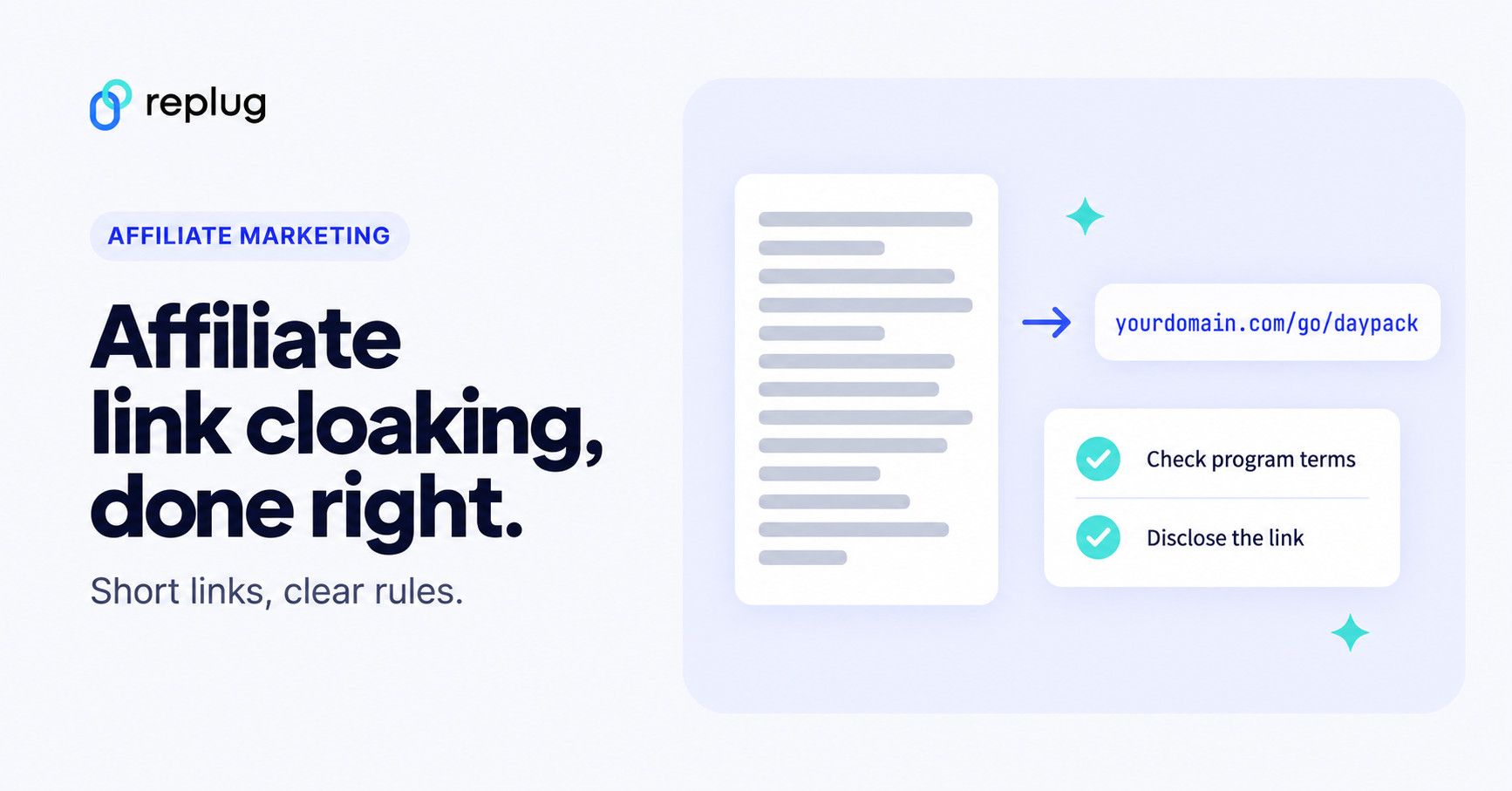
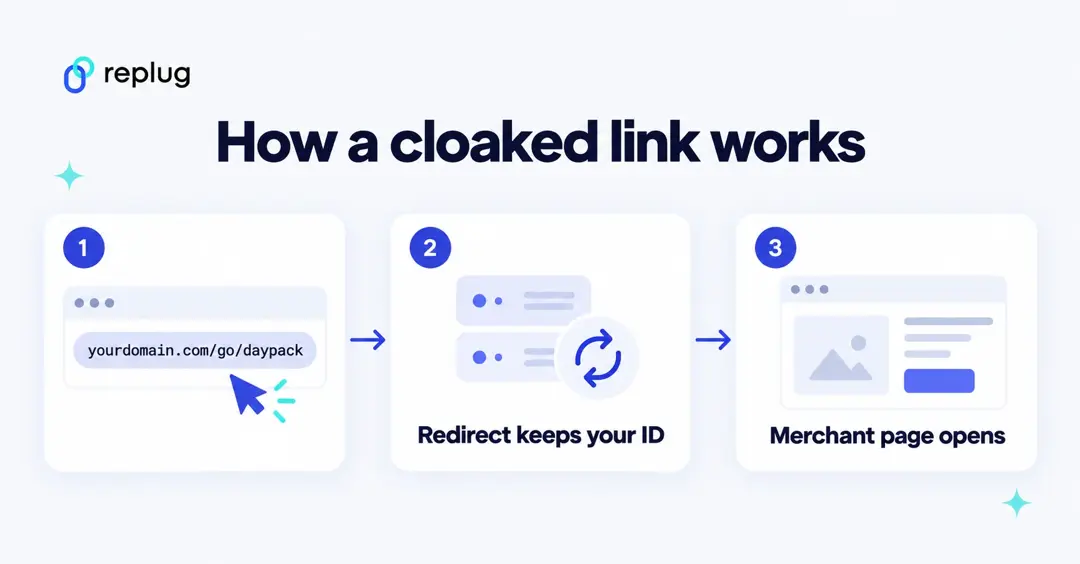
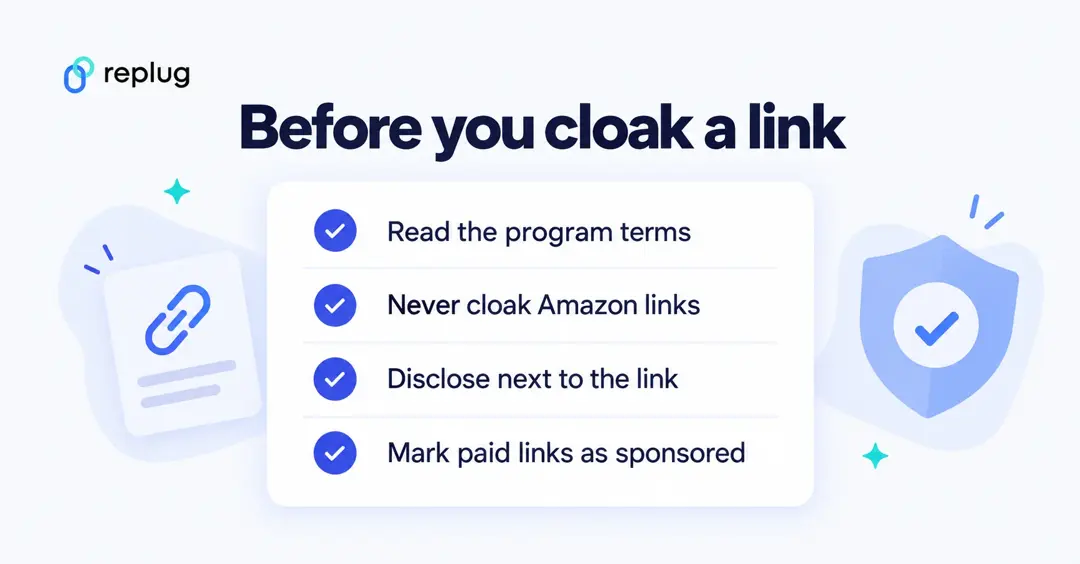
Quick answer: affiliate link cloaking means sharing a short, branded link (for example yourdomain.com/go/daypack) that forwards visitors to your long affiliate URL. People do it to make links readable, easier to update and easier to count. Two rules come first: some programs don’t allow it, and cloaking never replaces disclosure. Amazon’s Associates Program Policies say you will not “cloak, hide, spoof, or otherwise obscure” the URL of your site containing Amazon links, and will not “use a link shortening service … in a manner that makes it unclear that you are linking to an Amazon Site” (Amazon Associates Program Policies). So don’t cloak or shorten Amazon Associates links; share the links Amazon gives you. And the FTC expects a clear disclosure near any affiliate link, whether or not it is cloaked (FTC Endorsement Guides FAQ).
What is Affiliate Link Cloaking?
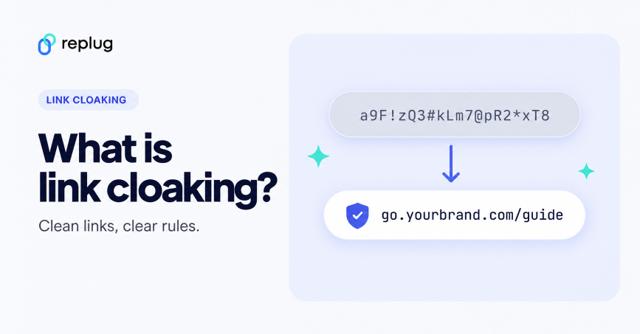
Affiliate Link Cloaking is a process of replacing the long and clunky affiliate product links with short, trackable links that point visitors to the same URL destination, but are trustworthy and brandable.
Expert affiliate marketers use affiliate link cloaking to make their affiliate product links look more trustable. You might be wondering how to get your hands on those short links. So let me briefly explain affiliate link cloaking, and then we will touch on more relevant topics you should know about.
Shall we?
Bloggers and marketers use affiliate link cloaking because visitors are hesitant toward longs and clunky product URLs. Most experts try to simplify the URLs, CTAs, and navigation so that readers feel safe.
Perhaps, people are skeptical about long URLs because scammers use several protocols in the URLs or page contents that lead to data theft or privacy issues.
Most website owners want to track the clickability on their site pages to analyze their on-page SEO strategies and understand the content performance through user behavior.
Anyway, affiliate link cloaking allows affiliate marketers and bloggers to minimize the complexity in the website navigation and provide a better user experience.
Should You Cloak Your Affiliate Links?
If you have ever thought about whether or not you should cloak your affiliate links, then this section might convince you to start paying close attention to affiliate link cloaking.
I like cloaking affiliate links because I don’t want to scare off readers – some visitors hover over the links and when they see the long, clunky URLs, they avoid clicking on those links.
Cloaking affiliate links doesn’t mean you want to hide your association with the brands. But instead, it makes readers feel safe when the links seem short and sweet.
Below is a video that will make you understand the importance and benefits of affiliate links.
Which affiliate programs don’t allow cloaking?
Every program sets its own rules, so read the operating agreement or policies of each program you join before you cloak anything. The best-known restriction is Amazon’s:
- Amazon Associates: the Program Policies say you will not cloak, hide, spoof or otherwise obscure the URL of your site containing Special Links, and will not use a link shortening service, button, hyperlink or other ad placement “in a manner that makes it unclear that you are linking to an Amazon Site” (Amazon).
- Amazon also excludes purchases referred through a “Redirecting Link”, a link that sends people to Amazon indirectly through an intermediate site without them clicking anything there, from qualifying purchases (Commission Income Statement). An automatic redirect through a cloaking tool can therefore cost you the commission as well as break the rules.
Other programs may allow branded redirects, ask you to keep their tracking parameters intact, or ban certain placements. When the terms don’t say, ask your affiliate manager. If you have already cloaked links that a program doesn’t allow, replace them with the program’s own links.
Cloaking doesn’t replace disclosure
A short link hides how a link earns money, so disclosure matters more, not less. The FTC’s guidance for affiliate links is to disclose the relationship “clearly and conspicuously” close to the recommendation, for example “I get commissions for purchases made through links in this post”. It also notes that readers might not understand the words “affiliate link” on their own, while “paid link” right next to the link should be adequate (FTC: Endorsement Guides, what people are asking). On social posts, the disclosure should sit with the endorsement itself, not only on a profile page or behind a “more” link (FTC: Disclosures 101 for Social Media Influencers).
Programs can add their own wording on top: Amazon Associates must state “As an Amazon Associate I earn from qualifying purchases” (Amazon Associates Operating Agreement).
Can You Make a Living Off of Affiliate Marketing?
The answer is yes; you can make a living off of affiliate marketing. Affiliate marketing is a lucrative business model if done right. The only caveat is that you must understand how it works.
Even though most affiliate marketers fail to make a significant amount of money with affiliate marketing, it’s still one of the most popular ways to earn money online.
When content creators put out valuable content to solve the audiences’ problems and mention the links to the products or services they have been using, the audience trusts them with their recommendations.
The best part is that bloggers, YouTubers, and TikTokers make money off of affiliate marketing the same way – they build a fan base, provide value to earn trust, and make money by recommending products.
Related: Affiliate Marketing Guideline for Beginners: A Step-by-Step Guide
Fundamental Steps of Link Cloaking
Since you have some idea of how link cloaking works, it’s important to discuss the fundamental steps of link cloaking.
i. Figure Out the Purpose of URL Shortening
Before you jump on cloaking random links on your blog just because you have seen influencers do this, it’s important to understand why you need to do this. A lot of bloggers blindly follow what experts are doing without having a plan in mind.
Most influencers and pro-bloggers cloak links because they don’t want messy links on their blogs. However, there are other reasons for cloaking links. For instance, short URLs or cloaked links also help in tracking clicks on those links. So figure out why you need to cloak links first.
ii. Identify the Website URLs to Trim Down
It’d be unfair if you start shortening the random URLs on your blog or website. Affiliate marketers and bloggers usually cloak affiliate product links to make them look decent. The reason is that affiliate product links are long and clunky, so cloaking them with a URL shortening tool makes them look nice.
You might not want to shorten the post or page URLs on your blog. Just stick to the affiliate product links when trimming the long URLs.
iii. Choose the Best URL Shortener
Cloaking links isn’t possible without an excellent URL shortener. Even though the core purpose of a link cloaking tool is to make links shorter and cleaner, it’ll be a bonus if any URL shortener provides additional features.
The value-added feature that you may want to look out for in a URL shortener or cloaking tool is click tracking. It’s vital to find out where visitors are clicking on your blog when it comes to affiliate marketing.
iv. Replace the Long URLs with Short Ones
Once you have shortened the long and clunky URLs on your blog using an external URL shortener or a WordPress plugin, the next up is the replacement of the long URLs with shorter ones.
It shouldn’t take so long if you’re using a tool like Lasso. However, you can always replace the links manually.
How to Cloak Links Using URL Shorteners?
If you’re curious about how to cloak affiliate or e-commerce products on your blog or website, then there are several tools to cloak links that might come in handy. Cloaking works much like disguising a link: visitors see a clean URL instead of the raw affiliate one.
One of the methods to cloak links on a blog or a website is by using a link cloaking WordPress plugin.
However, it’s only possible when you’re using the WordPress open-source program.
I use Replug for creating short links. It’s a top-notch URL shortener that could connect with custom domains for creating branded short URLs. Plus, it has some of the best features, such as click tracking, integrations, bio link, UTM codes, retargeting, and more.
Let me show you how Replug.io works.
Go to the Replug website and log in to your account (or sign up; the Free plan includes 100 short links).
On the Home screen, paste your affiliate URL into the “Paste a long URL to shorten…” field and click Shorten.

However, I’d highly recommend checking out a few of our articles on how to use branded URLs or the benefits of using the short branded URLs, etc.
Once you’re logged in to your Replug account, you’ll see the URL shortening field right at the top of the Home screen. All you need is to paste the URL you want to shorten; the link goes into your default campaign, and you can pick another campaign afterwards.
After you click “Shorten”, the Your link window opens. Click the pencil next to the shortened link to replace the random slug with a readable one, such as replug.link/daypack-review (custom slugs start on the Essentials plan), and choose the campaign and tags.
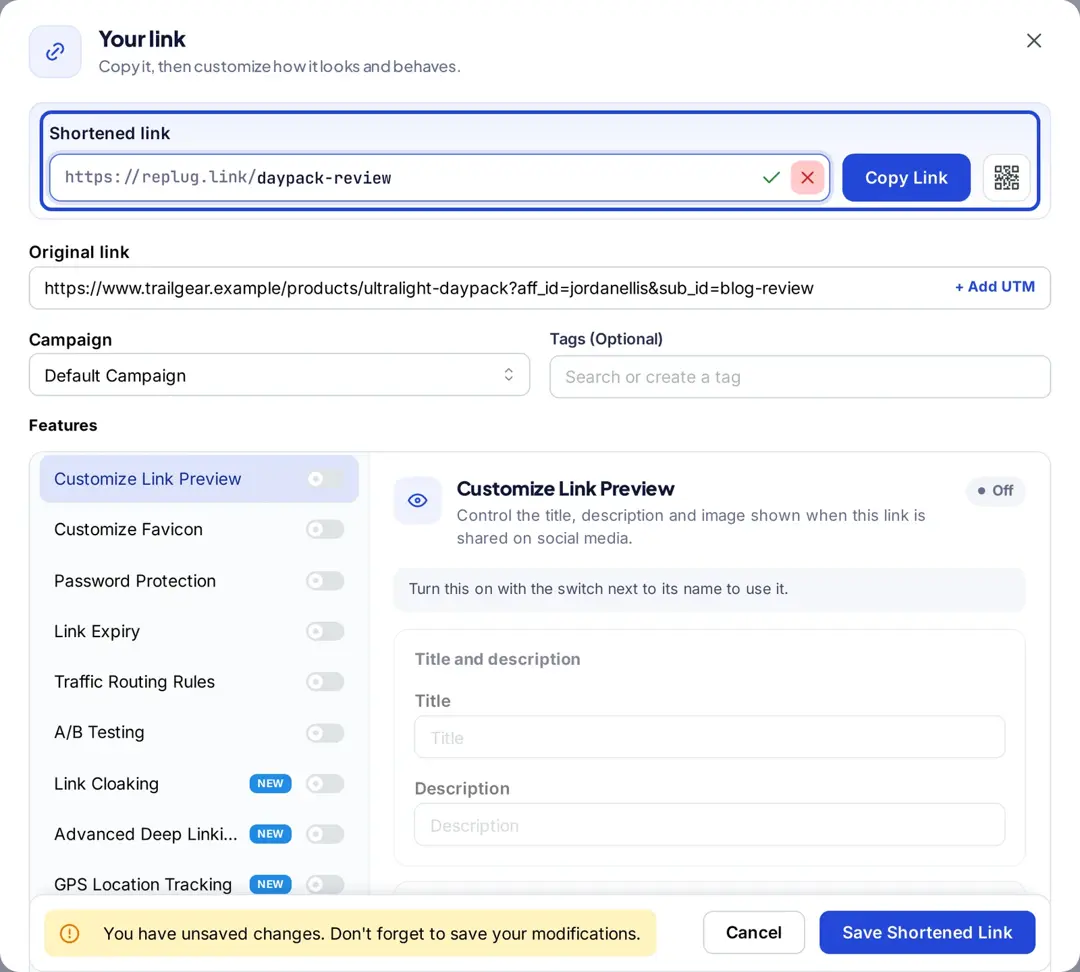
Turn on any extra features you need, then click Save Shortened Link, and you’re all set.
Now you have generated a short URL using Replug URL shortener.
You could later check out the Analytics section to analyze the clickability of the short URLs.
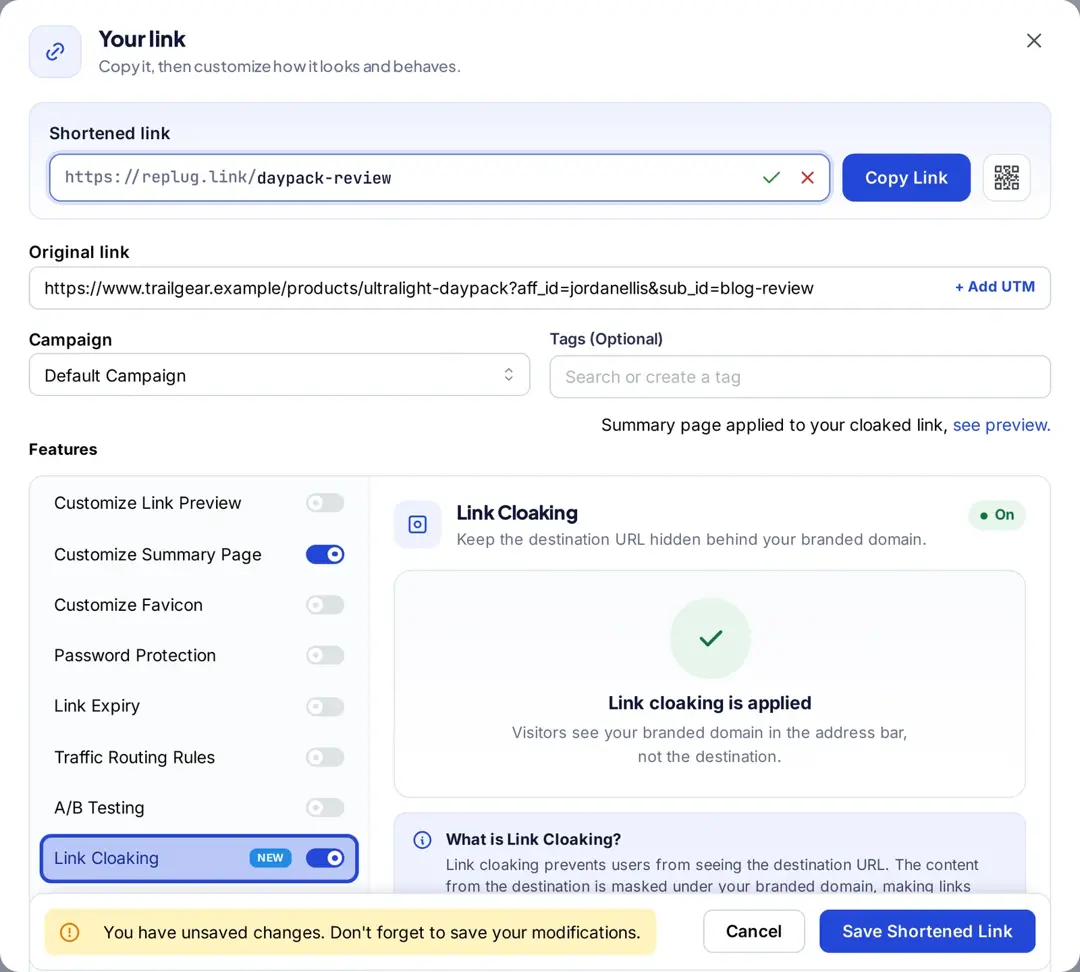
A normal Replug short link is a redirect: visitors see your short link before they click and the merchant’s page after. If you want the destination to stay under your branded domain, Replug’s Link Cloaking feature (Scale and Agency plans) shows the destination page inside your domain instead (Replug pricing). It only works with destination sites that allow framing, and it is exactly what Amazon’s policy rules out, so don’t use it for Amazon links. With any program, check the terms first.
Related: How to Setup Your Branded Short URL in Replug
5 Reasons Why You Should Cloak Affiliate Links
There are several reasons why you should cloak affiliate links, so allow me to share them with you.
Let’s take a look:
i. Clean Link Structure
Let’s admit that when you have short URLs instead of long ones, they look better. One of the aspects of URLs most people ignore is the link structure. If your affiliate link has a bunch of UTM codes, tracking codes, and serial numbers, people won’t trust your links, and rightly so.
So one of the biggest perks of cloaking affiliate links is that you clean up the link structure, which plays a vital role in improving the conversion rate.
ii. Clicks Tracking
You may or may not be properly tracking the affiliate conversion. Most bloggers and affiliate marketers rely on the merchants’ tracking – whatever the seller is using for affiliate sales tracking, and you have to rely on that.
However, when you’re using cloaked affiliate links, you have some control over click tracking. You know how many clicks have been recorded in your URL tracking system and you could match the number with your affiliate statistics. It’d help you figure out how accurate your affiliate dashboard is or enable you to find any discrepancies in the affiliate dashboard tool.
iii. Nofollow Affiliate Links
Most beginner affiliate marketers don’t even know that they should nofollow every affiliate link and most of them let the link juice pass to the merchant sites. When you let the link juice pass to the external sources, you’re letting the search engine bots slip to other sites.
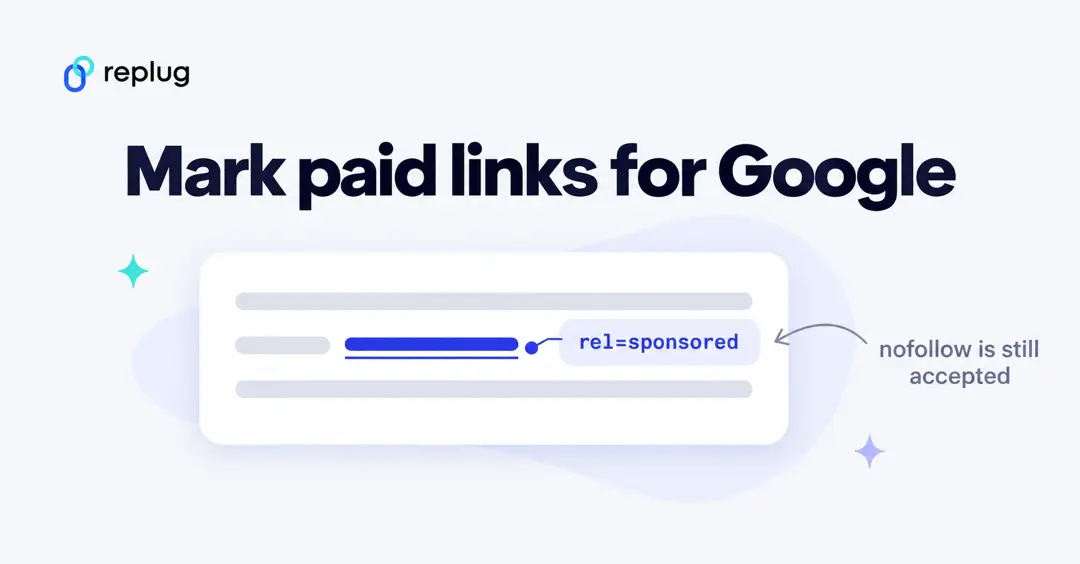
Google’s own guidance is to mark paid links, which includes affiliate links you are paid for, with rel=”sponsored”; rel=”nofollow” was recommended before and is still acceptable, though “sponsored” is preferred (Google Search Central: qualify outbound links). Most cloaking plugins and link tools can add the attribute for you.
There are WordPress plugins or nofollow scripts (for manual insertion) available for bloggers and affiliate marketers. Plus, you could always use a top-notch link management tool to have more control over your links, even when you’re shortening them.
iv. Increase Clickability
The experts in the SEO industry believe that visitors are likely to click more on short links rather than long links. You may have noticed that professional SEOs and bloggers keep their page URL slugs as short as possible. The same goes for other links, such as affiliate links.
Pro-bloggers and SEO experts think that shorter links get more clickability and add more relevance to the destination URL.
v. Ease of Management
When you’re using a URL shortener to track clicks or conversion, you don’t just have control over data and statistics, but you also have ease of link management. Using a tool like Replug would enable you to track clicks on the short links as well as help you retarget the audiences who have clicked on the links.
So these were some of the main reasons why you should cloak affiliate links and make this process a part of your affiliate marketing regime.
Two Reasons Why Most Affiliate Marketers Fail At Affiliate Marketing
1. Zero Understanding
The no. 1 reason why most affiliate marketers fail is that they don’t figure it out. They think that just because they’ve put out a link to an affiliate product, people will click and buy the product.
It doesn’t work that way – you have to convince people that this product is worth buying. In some cases, the affiliate marketer purchases the product themselves to test out and share the results with the audience. It earns them the trust and loyalty of the audience. Be ready to go above and beyond to earn trust online.
2. Get Quick Rich Scheme
Affiliate marketing isn’t a quick money-making scheme. You’re most likely to fail at affiliate marketing if you don’t have the patience. It ain’t work too fast. Most bloggers who successfully monetize their blogs with affiliate marketing have had loads of failures, and they always learn from their mistakes.
If you want quick money out of it, you’re destined to fail at affiliate marketing. It doesn’t matter if you start with bloggers, YouTube, Instagram, or TikTok – it makes no difference unless you understand the game.
So you’ll be better off if you learn how to make money from affiliate marketing before jumping on the bandwagon of affiliate marketing.
Do Affiliate Links Affect SEO?
Affiliate links drive website visitors to the merchant’s website or landing page. It’s not rocket science that driving traffic to a page or website helps the destination page or website because everyone knows this.
But there is a caveat: if a link is pointing the visitor in a specific direction per se, then the destination page would benefit from it unless the link is nofollowed.
Whenever a link is nofollowed, the search engine bots are directed not to follow the link. This way, the bots don’t travel through that link. Thus, the page or website keeps the bots for a little longer.
However, some SEOs believe that even nofollow links add credibility and trustworthiness in the search engines’ eyes, but not in the same way as the dofollow links.
What Google does say is that affiliate links themselves are not the problem: its spam policies target “thin affiliation”, meaning pages that copy merchant descriptions without adding original content, and say good affiliate pages add value with original reviews, testing or comparisons (Google spam policies). Cloaking a link doesn’t change how Google sees the page around it.
If you’re wondering whether or not the affiliate links affect SEO, then here are a few cases when affiliate links could potentially affect the SEO performance of a site:
i. Dofollow External Links
Since affiliate links are external or outbound links because they’re directing visitors to a merchant’s website, they could harm your site SEO if they’re dofollow. Most bloggers and affiliate marketers keep their affiliate links nofollow to avoid passing the unnecessary juice to the merchant’s website.
It’s safe to say that dofollow external links could affect your site’s SEO unless they aren’t taken care of from an SEO standpoint.
ii. Broken Affiliate Links
When affiliate links are broken, they’re quite damaging for an affiliate marketing website. There are several reasons why a broken link is dangerous; for instance, it doesn’t generate a sale, and it drives visitors away. This can frustrate readers when they don’t land on the intended merchant page.
So no doubt, a broken affiliate link could result in a bad user experience for your website visitors. And you can’t dominate with SEO techniques if you’re providing a bad user experience to the visitors.
Furthermore, there are WordPress plugins and online tools available that scan your site and report all the broken links.
iii. Clunky Product Links
Have you ever seen a long and clunky product link on e-commerce sites or affiliate blogs? When you hover on the products, you see unending URLs that seem scary at times.
One of the disadvantages of those clunky URLs is that they aren’t optimized for SEO. Plus, it scares visitors off due to their scammy appearance. Such affiliate product links are a no-go.
iv. Bunch of Affiliate Banners
A ton of affiliate product banner ads could frustrate visitors that are trying to learn about the product or find an answer to their query. You don’t have to bombard the visitors with several banner ads. Instead, put a couple of banner ads on the side or in the content if you have to put the banner ads.
Moreover, these image-based banner ads often increase page load time and can shift the layout as they load, which can hurt your Core Web Vitals. Core Web Vitals are the metrics Google uses for loading (Largest Contentful Paint), interactivity (Interaction to Next Paint) and visual stability (Cumulative Layout Shift); web.dev explains each one.
So clearly, loads of banner ads could affect your site’s SEO performance.
Related: SEO Links for Replug Campaigns
How Many Affiliate Links Are Too Many?
The key to winning at affiliate marketing is figuring out the balance between several things, such as:
- Niche identification
- Target audience
- Engaging content
- Relevant affiliate products
However, there is no guarantee that more affiliates would bring in more money or fewer affiliate programs would earn you less money.
It seems impossible to pull off if you’re doing something wrong in affiliate marketing. On the other hand, it may look very simple to those bloggers who figured this out.
I’ve written a blog post about joining multiple affiliate programs and the gist of the blog post was that you should join multiple affiliate programs as long as they are in line with your content strategy.
A lot of affiliate bloggers say that building a topical authority on your blog or affiliate site is the stepping stone to start generating sales.
The way it works is that you test out different topics by publishing a handful of articles across three to four categories.
Once a cluster of topics starts getting traction from search engines, you could double-down on that and write a bunch of more articles on that topic/category and become an authority in that area. That’s how you build topical authority around a certain topic or category.
So several affiliate links or affiliate programs won’t make a difference unless your content is worth paying attention to from the readers’ standpoint.
However, indeed, placing dozens of the same affiliate links in a brief blog post may annoy the readers, so you need to create a balance in that area.
Make sure that your blog doesn’t look pushy when it comes to affiliate product insertion.
Related: What is a URL slug: Its impact on SEO, examples, best practices, & more
Are You Ready to Cloak Affiliate Links?
We’ve explained what affiliate links are and how they work on affiliate blogs.
The reason why we discussed this topic is that it’s vital to use link cloaking, especially when you’re monetizing blogs with affiliate marketing.
If you have been paying attention to quality content, link building, site design, page speed, and on-page SEO, then you can’t mess up with long and clunky affiliate links.
Several branded URL shorteners and affiliate link cloaking tools are available on the market. Choose the link cloaking tool that provides in-depth reporting and click-tracking so that you keep track of your clicks on the affiliate links.
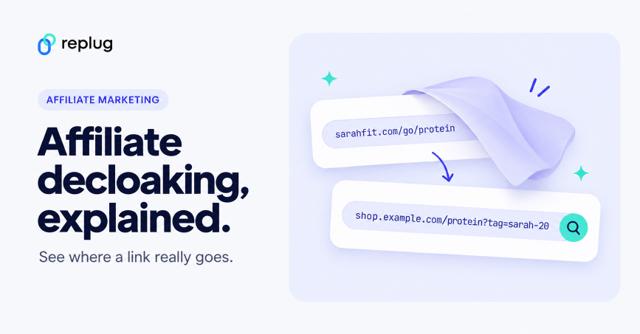
New to affiliate marketing? Start with what affiliate links are and how they work. To see which placements earn, read our guide to affiliate link tracking, and if you want to know how people reveal the destination behind a cloaked link, see affiliate decloaking.
FAQ
Is affiliate link cloaking allowed?
It depends on the program. Many programs let you share their link through a redirect, but some restrict it. Amazon Associates does not allow cloaking or shortening that hides that you are linking to Amazon. Read each program’s terms, and disclose your affiliate relationship either way.
Can I cloak or shorten Amazon affiliate links?
No. Amazon’s Associates Program Policies say you will not cloak or obscure your site’s URL and will not use a link shortening service in a way that makes it unclear you are linking to Amazon. Use the links Amazon generates for you.
Does cloaking an affiliate link affect the commission?
A redirect that keeps the program’s full tracking URL intact normally still credits you, so test every cloaked link and compare clicks with your program’s report. Some programs exclude traffic sent through automatic redirects, as Amazon does for “Redirecting Links”.
Does affiliate link cloaking hurt SEO?
The cloaking itself is neutral. What matters is marking paid links with rel=”sponsored” (or nofollow) and publishing original content around them, as Google’s guidance on outbound links and thin affiliate pages asks.
Do I still need to disclose cloaked affiliate links?
Yes. The FTC expects a clear disclosure close to the link, such as “I get commissions for purchases made through links in this post”, no matter what the link looks like.

Muhammad Ahsan Jamal