Every marketing message needs a final spark; a clear, direct step that turns a passive visitor into an active customer. This is where the CTA, or call to action, plays its part. By guiding your audience from curiosity to action, it helps increase engagement and turns interest into measurable results.
But what is a CTA in marketing, and why does it matter so much?
In this blog, we’ll look at what CTA stands for in marketing, explain the difference between soft CTA and hard CTA, and look at powerful CTA examples in marketing. For a longer list, see these CTA examples from real brands.
Plus, we will explore practical tips and see how tools like Replug’s call to action generator help you create a top-notch CTA that increases your conversion rate.
What does CTA stand for in marketing?
CTA stands for call to action. In marketing, it’s what tells your audience what to do next, like “buy now”, “subscribe”, or “download”.
The call to action marketing definition is simple: it’s about guiding your audience from just looking to actually doing. CTAs appear as buttons, hyperlinks, banners, or even phrases in videos and emails. They might be as direct as “start free trial” or as gentle as “discover more”, but their purpose stays the same: lead people toward action.
CTA in marketing: why it matters
What does CTA mean in marketing? It means turning curiosity into clicks, and clicks into measurable business results.
Think of your content as a conversation. Without a CTA, that conversation stops short; you’ve sparked interest, but you haven’t shown what to do next. Effective CTA marketing bridges that gap. It keeps visitors engaged, increases your ROI, and helps you guide each person through the customer journey, from awareness to consideration and finally to decision.
In other words, CTA in marketing isn’t just about adding a button; it’s about creating a clear path your audience wants to follow.
Types of CTAs: soft CTA vs. hard CTA
Successful marketing often uses a mix of soft CTA and hard CTA, matched to where your audience is in the funnel.
| Type | What it does | Examples | When to use |
| Soft CTA | Encourages low‑commitment, exploratory steps | – Learn more – See how it works – Discover more | Early stages: Building trust and educating |
| Hard CTA | Pushes for a final, decisive action | – Buy now – Subscribe – Download now | Later stages: When your audience is ready to convert |
Using both keeps your CTA marketing natural: soft CTAs spark interest; hard CTAs convert that interest into results.
Also read: Call to action for social media: 15 best examples
Examples of CTA in marketing
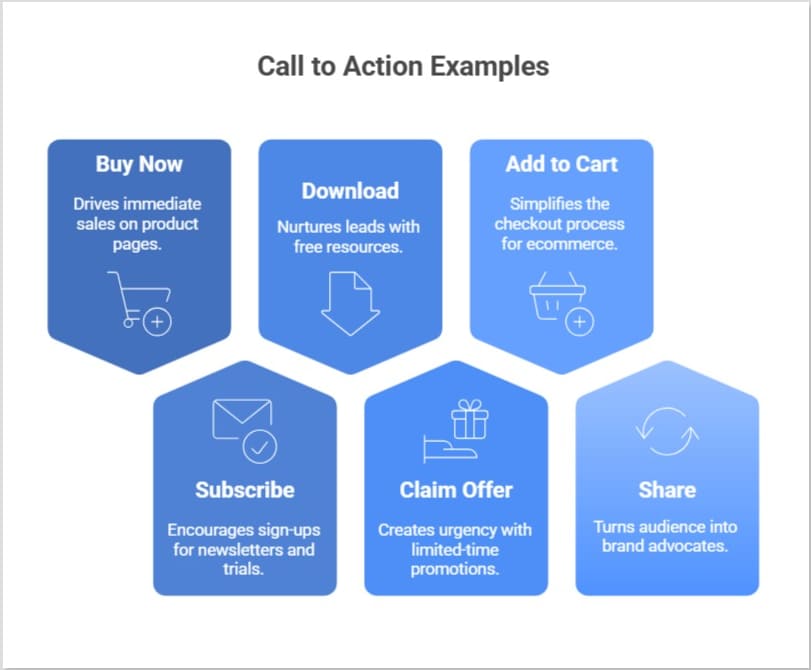
Here are some common yet, effective examples of effective CTAs in marketing and their primary purpose:
- Buy now → ideal for product pages to drive immediate sales
- Subscribe → great for email newsletters, free trials, or community sign‑ups
- Download → offers free resources to nurture leads
- Claim offer → works well with limited‑time promotions to create urgency
- Add to cart → simplifies ecommerce checkout
- Share → turns your audience into brand advocates by encouraging social sharing
Each CTA is short, clear, and purpose‑driven, showing exactly what action you want the user to take.
Want inspiration for call-to-action phrases for your marketing campaigns? Here’s our list of 100+ killer CTA phrases you don’t want to miss!
How to write a call to action, step by step
A strong call to action has three qualities: it is clear (the reader knows exactly what happens after the click), it gives a reason to act now rather than later, and it is relevant to the page and the person reading it. These steps build all three into one line.
- Pick one action. Decide the single thing you want from this page or post: a sign-up, a booking, a download or a purchase. One CTA per section is easier to act on than three competing ones.
- Start with a verb. Get, start, book, join, download, claim. The verb tells people what to do.
- Name what they get. “Download the 10-step checklist” beats “Submit” because the reader sees the reward before they click.
- Give a true reason to act now. A real deadline, a limited number of seats or a launch-day price. Leave it out if there is none; invented urgency costs trust.
- Match the stage. A soft CTA (“See how it works”) for someone just learning about you, a hard CTA (“Buy now”) for someone ready to decide.
- Make it clickable and easy to see. Put the words on a button or a link, give it contrast and space, and place it where the reader finishes the point you are making.
- Remove the risk. A short line such as “No credit card required” or “Cancel anytime”, only if it is true, answers the doubt that stops the click.
- Measure and test. Count the clicks, then try a second version of the wording or placement and keep the one that performs better.
Here is how that looks in practice. Emily Carter runs a small bakery in Austin and wants more catering inquiries from her website:
- Before: “Submit”
- After: “Get my free catering quote”
- With a reason to act now (true for her): “Book by Friday for holiday delivery”
How to add a call to action to a link
A CTA link is a link whose words are the call to action, such as “Book your free consultation” instead of a bare URL or “click here”. It works anywhere you can paste a link: emails, captions, bios, chat messages and documents.
- Write the anchor text as the action. The linked words should say what happens next, so the reader knows what they are clicking.
- Point it at the exact page. Send people to the page that completes the action (the booking form, the product, the sign-up), not to your home page.
- Use a short, readable URL where the link is visible. In social posts, bios and printed material the URL itself is part of the message. A short, branded link is easier to read and trust, and a link shortener can count the clicks.
- Use a phone link for click-to-call CTAs. A link that starts with
tel:followed by the number (for exampletel:+15125550123) opens the phone app on mobile.
CTAs on QR codes: a printed QR code needs a call to action next to it, because the code alone doesn’t say why anyone should scan. “Scan to see today’s menu” or “Scan for 10% off your first order” tells people what they get. Our QR code marketing guide covers placement and tracking.
CTAs on links to other sites: when you share someone else’s article, the page isn’t yours, so you can’t add a button to it. Replug’s CTA campaigns solve that by showing your message over the page your short link opens, as described below. CTAs are available on the Essentials plan and above, per replug.io/pricing.
How to create an effective call to action for marketing?
There are many tools out there to help you craft a compelling call to action as part of your marketing strategy. However, Replug stands out because it offers a custom overlay creator designed to simplify the entire process.
Inside Replug, you can create a dedicated CTA campaign, choosing your message, button text (buy now, subscribe, or any custom copy), and styling it to match your brand’s look and feel. You can also create dynamic CTAs that adapt based on your audience or campaign goals, helping you keep messaging fresh and personalized without starting from scratch.
Moreover, you can decide where your CTA appears: as a pop‑up, using a banner template, or even on a bridge page when direct overlays aren’t supported on platforms like Facebook or Google.
This means you’re not just making a single button, you’re building a consistent, branded experience across all your links and content.
If you’d like to see exactly how to set this up, check out our step‑by‑step guide to creating CTA campaigns in Replug.
Best practices for effective CTA marketing
Crafting CTAs isn’t only about writing clever text; it’s about understanding what will truly motivate your audience to act.
Start by knowing your goal
Before writing your CTA, decide what you want to achieve. Are you trying to get sign‑ups, drive direct purchases, or increase downloads? A clear goal ensures your CTA aligns with your content and your business strategy.
Use action‑oriented language
Strong verbs like “start”, “discover’, “join”, “buy now”, or “subscribe” add energy and clarity. They don’t just tell users what to do; they help them feel ready to do it.
Focus on benefits, not just actions
People click when they see what’s in it for them. Instead of “submit”, try “get your free guide”. This approach shifts attention to the value your offer provides.
Design for visibility
A CTA button should catch the eye without overwhelming the design. Contrast with surrounding colors, add whitespace, and keep fonts bold yet clean.
Strategic placement matters
CTAs don’t always belong only at the bottom. Try placing them after product descriptions, in blog posts, or as exit pop‑ups. Replug even lets you add branded CTAs on curated content you share, so every link becomes part of your funnel.
Note on platform restrictions
Some digital platforms like Facebook, Google, or YouTube restrict adding custom CTAs directly due to iframe or embed policies; which can be frustrating for users, especially affiliates. To work around this, you can use Replug to create a bridge page: a branded intermediate page that appears before the final destination. It hosts your CTA, so you still guide users to act, even when the original site doesn’t allow it.
Also read: Top call-to-action tools – Proven CTA tips and tricks
Keep it concise
Users often skim online. A short, direct CTA like “shop the collection” or “download” now usually outperforms longer, complex phrases.
Use CTAs in bio links and captions
Add CTAs to Instagram bios, TikTok profiles, and captions to drive clicks. With tools like Replug, you can turn one bio link into a branded landing page with multiple CTAs. It is the all-in-one link management platform that is perfect for affiliates and creators who want to track every click.
Create urgency where appropriate
Phrases like today, “limited‑time offer”, or “don’t miss out” gently nudge users to act sooner rather than later.
Test, learn, repeat
Use analytics and A/B testing to see which CTA marketing ideas resonate most. Even a single word change can move your conversion rate.
Great CTA marketing is an ongoing process: set clear goals, test, learn, and refine.
Benefits of using the right CTA
A well‑planned CTA strategy does more than increase clicks. It transforms how your audience experiences your brand:
- Guide visitors to act with confidence: Clear, well‑placed prompts remove hesitation. When visitors know exactly what to do next, they’re more likely to take action; whether that’s buy now, subscribe, or download.
- Focus on real value, not just clicks: Effective CTAs highlight what matters most to your audience: exclusive access, discounts, or helpful content, turning curiosity into meaningful engagement.
- Track performance and refine your strategy: With tools like Replug, every click can be tracked. This means you see which CTAs get real results, run A/B tests, and keep improving your conversion rate over time.
- Add CTAs even where platforms restrict them: Some platforms (like Facebook, Google, or YouTube) limit direct CTAs because of iframe or embed restrictions. Replug solves this by letting you create customizable bridge pages.
- Build brand trust through consistency
When your CTAs match your design and tone everywhere, from emails to shared links visitors feel a seamless brand experience. This consistency builds confidence and makes users more comfortable saying yes.
A/B testing: refine what really works
When using a CTA in digital marketing, what works best isn’t always obvious. That’s why A/B testing (also called split testing) is essential: it helps you compare two or more versions of a call to action to see which performs better and drives more conversions. Our A/B testing basics guide explains how it works.
Split testing allows you to test different elements like copy, color, size, placement, or design, to identify the most effective combination for engagement and conversions.
For example, you might test:
- Buy now vs. Get yours today
- CTA button color or size
- Placement at the top, middle, or end
- Bold button vs. simple text link
By systematically running these experiments and analyzing the data, you make data‑driven decisions instead of relying on guesswork. Over time, you can refine your CTAs by iterating on successful variations and discarding the ones that don’t perform.
Tools like Replug make this process easier: you can quickly create multiple CTA versions, track clicks, and see what resonates best with your audience. That way, your CTA marketing strategy keeps improving, backed by real insights rather than assumptions.
Start crafting CTAs your audience wants to click
Using a CTA in your marketing campaigns isn’t just about telling people what to do. It’s about creating a moment that moves them from interest to action.
Using right wording, placement, and tools like Replug, you can craft CTAs that feel authentic and turn passive visitors into loyal customers.
You can take your CTA strategy even further by using a short URL
to track performance and enhance user experience, ensuring every click brings you closer to meaningful engagement.
FAQs about CTA marketing

Amna Yawar